

There was a time when a speed shop was much more than a place to buy horsepower.
Long before the days of online catalogs, computerized ignition systems, and overnight delivery, a good speed shop was a gathering place for people who were serious about making cars go faster. Racers came through the door looking for parts. Mechanics traded information across the counter. Drivers talked about the next race, and someone always seemed to know where to find the camshaft, cylinder head, carburetor, or other hard-to-find part that could make the difference between winning and losing.
In northern New Jersey, one of those places was connected to a man who had already lived several lifetimes in American racing before many of the country’s famous speed shops even opened their doors.
His name was Frankie DelRoy.
Today, the name Del Roy Speed Shop is difficult to find in the historical record. The story becomes even more complicated because the business appears under several variations of the name. One of the strongest pieces of surviving evidence identifies the company as Calder Delroy Speed Parts, Inc., located on U.S. Route 46 near River Drive in East Paterson, New Jersey.
But the man behind the business is much easier to trace.
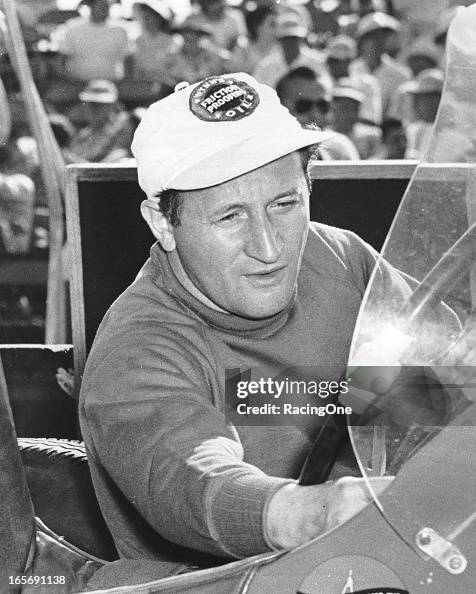
Frankie DelRoy was a racer, mechanic, race-car builder, speed-equipment dealer, factory racing manager, and eventually one of the most important technical officials in American championship racing.
The story of his New Jersey speed shop is really the story of a man who spent nearly his entire life around fast cars.
Frankie DelRoy Discovered Racing in Paterson
Frank DelRoy was born Frank DeRosa in Philadelphia in 1912, but he grew up in Paterson, New Jersey.That detail is important because Paterson and the surrounding northern New Jersey area had a surprisingly rich connection to early American automobile racing. The region was filled with garages, mechanics, machine shops, racers, and young men who were fascinated by the new automobile.
DelRoy was one of them. His father apparently had other plans for his son. He wanted Frankie to become a musician and sent him to violin lessons. The young DelRoy had different interests.
On the way to his lessons, he passed a garage where racer Zeke Meyer kept his race cars. According to stories later told about DelRoy, those race cars proved considerably more interesting than practicing the violin.
Eventually, his father discovered that Frankie was spending his time around race cars instead of studying music. The resulting argument became part of DelRoy’s colorful legend, with the violin reportedly ending up broken over his head. The violin lost. Racing won. That decision would shape the rest of his life.
From New Jersey Mechanic to Indianapolis
During the 1930s, DelRoy worked his way deeper into automobile racing. He became a mechanic and eventually took on one of the most dangerous jobs in American motorsports: riding mechanic.
The Indianapolis 500 of that era was a very different race from the one we know today.
Cars carried two men. The driver concentrated on controlling the car while the riding mechanic watched the machinery, checked oil, made adjustments, and dealt with mechanical problems while traveling around the Indianapolis Motor Speedway at extraordinary speeds.
It was dangerous work, and it required a mechanic who understood the car almost as well as the driver did.
DelRoy became very good at it.
In 1937, he rode with Bill Cummings in the Boyle Valve Special at Indianapolis. Cummings qualified on the pole, making DelRoy part of one of the most important qualifying performances of the



Leave a Reply
Your email is safe with us.