
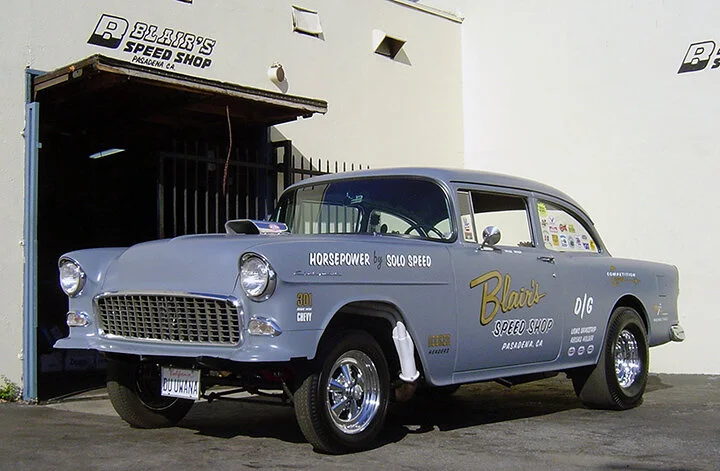


Don Blair: The Speed Merchant Who Shaped Southern California Hot Rodding
Long before Southern California became the proving ground for American performance, Don Blair stood on the streets of Highland Park tuning his future. Born on September 3, 1921, Blair grew up during the formative years of the hot rod movement. He attended Lincoln High School in South Pasadena and sharpened his mechanical instincts at Frank Wiggins Trade School in Los Angeles. The bustling parts houses and machine shops of the early 1940s L.A. Basin became his finishing school, and Blair absorbed every trick the old craftsmen offered.
When Blair’s grandfather passed in 1945, a modest inheritance gave young Don the springboard he needed. At twenty-five, he purchased a lot on Arroyo Parkway and opened the original Blair’s Speed Shop. His brother Bruce stepped in from the outset, wrenching engines and fabricating chassis with the cool eye of a seasoned mechanic. Blair needed more room within a few short years, and by the late 1940s he erected his first proper shop on Foothill Boulevard in Pasadena, with Tim Timmerman hired as his earliest employee. The space filled up fast; Southern California’s speed-hungry crowd made sure of that.
By 1950–51 Blair scored a larger home base: the former Thornton and Carlson Candies building at 2771 E. Foothill Boulevard, complete with a showroom made for gleaming speed parts. Even with the growing demands of the shop, Blair never backed away from competition. The dry lakes still called his name.
In 1945 Blair stamped his name into hot rod history. As a Pasadena Roadster Club member, he took a European Mercedes-Benz Roots supercharger, bolted it onto a Ford Flathead V8, and stuffed the combination into his roadster known as “the Goat.” The setup ripped to 141 MPH at El Mirage and averaged 130.27 on the clocks—extraordinary numbers in an era when forced induction remained the territory of innovators and daredevils. Blair’s hands-on engineering and relentless experimentation earned him a reputation that spread well beyond Southern California.
The 1950s turned Blair’s Speed Shop into a cornerstone of early Ford performance. The shop became famous for dropped front axles, crisp chassis setups, and a no-nonsense, results-first approach that racers trusted. As the industry shifted toward late-model iron, Blair kept ahead of the tide. By the late 1950s and early 1960s, Blair’s defined the benchmark for Tri-Five Chevrolet straight-axle conversions. Other builders followed their lead; few dared to compete head-to-head.
The shop’s influence expanded again when Irwindale Raceway opened in 1965 just down the road. Every weekend, Blair’s Speed Shop transformed into a command center for drag racers hunting spark plugs, oil, gaskets, nitromethane, alcohol, race gas, and emergency fixes. Blair backed an impressive roster of racers, including Robbie Robison, Don and Betty Walker, Ruel Nicol, Don Lindford, and many others. But one name stood above the rest: Steve Bovan.
The early 1960s marked the beginning of Blair’s high-profile involvement with Bovan. Blair’s Speed Shop sponsored the Bovan & Castro 1961 Corvette, a machine that turned heads wherever it ran. Soon after came Bovan’s 1964 Plymouth 426 Wedge match racer, another Blair-backed stormer that helped define the era’s match-race culture. In 1965, Blair, Bovan, and Indy 500 legend Sam Hanks made national headlines with Steve’s blown, nitro-fed 1965 427 Chevy II match racer—an animal of a car that embodied the raw aggression of mid-sixties drag racing.
Bovan’s next act kept the momentum rolling. Blair’s Speed Shop fielded the flip-top 1968 Chevrolet Camaro funny car, a wild machine constructed in-house by Blair’s chassis-master Mike Hoag. The car carried the Blair name across strips nationwide and strengthened the shop’s already formidable reputation.
After twenty-five years at the helm, Don Blair sold the business in 1974 to gasser racer and longtime employee Phil Lukens. But Blair wasn’t finished with speed. In 1985 he launched Blair’s High Performance, an engine-building shop in Glendora that specialized in sprint car powerplants. From 142 S. Glendora Avenue, Blair once again supplied racers with hard-running engines built with precision and purpose.
Don Blair passed away on September 29, 2011 at age ninety, leaving behind one of the richest legacies in hot rodding. His career spanned dry lakes runs, Flathead innovation, early Ford chassis craft, Tri-Five transformations, nitro-fueled match racing, and the high-output sprint cars of the 1980s. Blair’s Speed Shop didn’t just tune engines—it helped shape the identity of American performance culture.



Leave a Reply
Your email is safe with us.